Top 10 slow cooker questions, answered
Slow cookers are one of the most practical kitchen appliances you can own — load them up, walk away, and come back to a finished meal. But for all their simplicity, they generate a surprising number of questions. Should you brown meat first? Can you use frozen ingredients? Why does dairy always curdle? This guide covers the 10 most common slow cooker questions with expert-level answers, plus practical tables and charts to make you a more confident cook.
How a Slow Cooker Actually Works
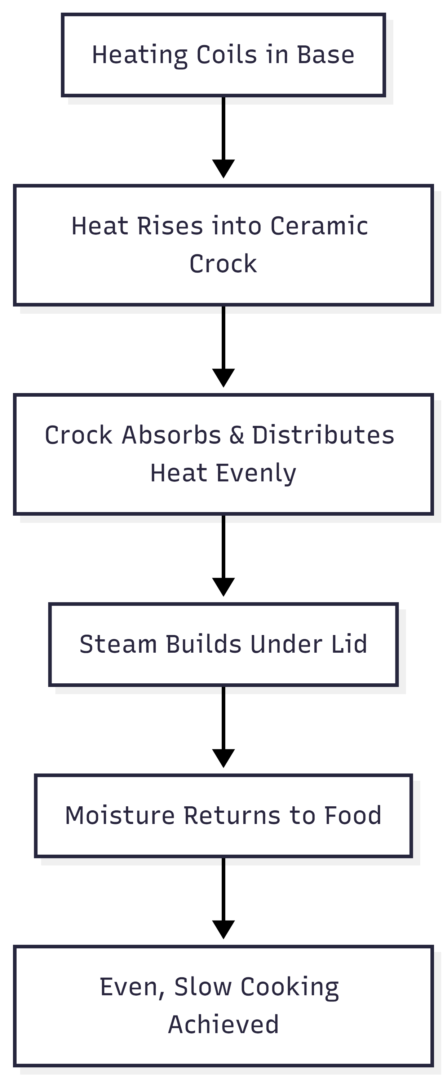
Before diving into the questions, it helps to understand the mechanics. A slow cooker has three components: the base (where heating coils sit), the stoneware or ceramic crock, and the lid. Heat rises from the base into the crock, which absorbs and distributes it evenly. The lid traps steam and returns moisture to the food continuously — essentially functioning as a built-in baster. This closed-loop system is what makes slow cookers so effective at tenderizing tough cuts of meat and developing deep flavor without any effort on your part.
Most slow cookers do not have a thermostat that maintains a fixed temperature. Instead, the temperature inside the crock fluctuates based on how full the pot is and the water content of the recipe. The goal is always to reach a food-safe temperature on either setting.
1. Is It Safe to Leave a Slow Cooker Unattended?
Yes. Slow cookers are specifically engineered for unattended cooking. They draw roughly the same wattage as one and a half 100-watt light bulbs, making them energy-efficient and safe to run for 8–10 hours. Programmable models shift automatically to a “warm” setting once the cooking cycle completes, keeping food at a safe holding temperature until you’re ready to serve.
The main safety rules: keep the cooker on a flat, stable surface away from walls and cabinets, never use it with a damaged cord, and always follow the manufacturer’s guidelines.
2. What Is the Difference Between Low and High Settings?
Both settings reach essentially the same end temperature — the simmering point — but they take different amounts of time to get there. Low typically hovers around 190–200°F during the cook cycle, while High runs around 280–300°F. The practical upshot is that Low takes roughly twice as long as High to cook the same dish.
| Setting | Approximate Temp | Typical Cook Time | Best For |
|---|---|---|---|
| Low | 190–200°F | 6–10 hours | Tough cuts, all-day meals |
| High | 280–300°F | 3–5 hours | Faster weeknight meals |
| Warm | 145–165°F | Holding only | Keeping cooked food safe |
One important nuance: “Warm” is not a cooking setting. It is a holding temperature. Never start raw ingredients on Warm — the food will sit in the bacterial danger zone (40–140°F) for too long before reaching a safe internal temperature.
3. Can You Use Frozen Meat in a Slow Cooker?
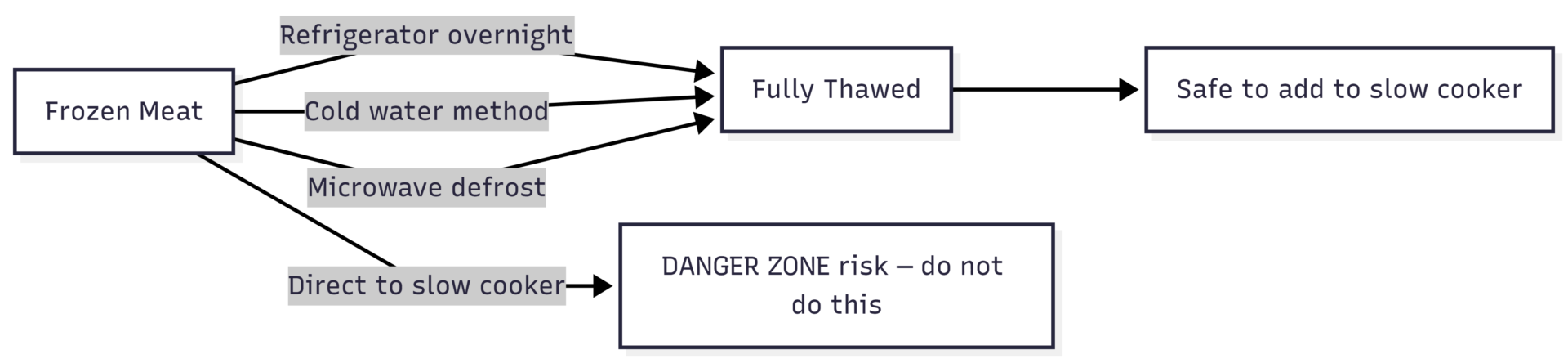
No — this is one of the most important safety rules. Placing frozen meat in a slow cooker means it spends an extended period in the bacterial danger zone (40–140°F) while it thaws and begins cooking. Bacteria like Salmonella and E. coli multiply rapidly in this range, and the slow, gradual heat rise of a slow cooker is not fast enough to kill them before they can cause illness.
Always thaw meat completely in the refrigerator, under cold running water, or in the microwave before adding it to a slow cooker. The only exception is commercially packaged “dump and go” frozen meals that are explicitly designed and tested for slow cooker use from frozen.
4. How Much Liquid Do You Need?
Far less than you think. Slow cookers trap moisture — there is very little evaporation because the lid recirculates steam back into the food. Using a conventional recipe’s liquid quantity will result in a watery, flavorless dish.
| Recipe Type | Recommended Liquid |
|---|---|
| Soups and stews | 1–2 cups (food should be mostly submerged) |
| Pot roasts and braises | ½–1 cup (just enough to create steam) |
| Chicken pieces | ¼–½ cup |
| Beans (pre-soaked) | Just enough to cover by 1 inch |
| Pasta dishes | Follow recipe; reduce by 25% from stovetop amounts |
If you end up with too much liquid at the end of cooking, remove the lid and cook on High for 20–30 minutes to reduce the sauce. Alternatively, whisk a tablespoon of cornstarch with two tablespoons of cold water, stir it in, and cook on High for 15 minutes.
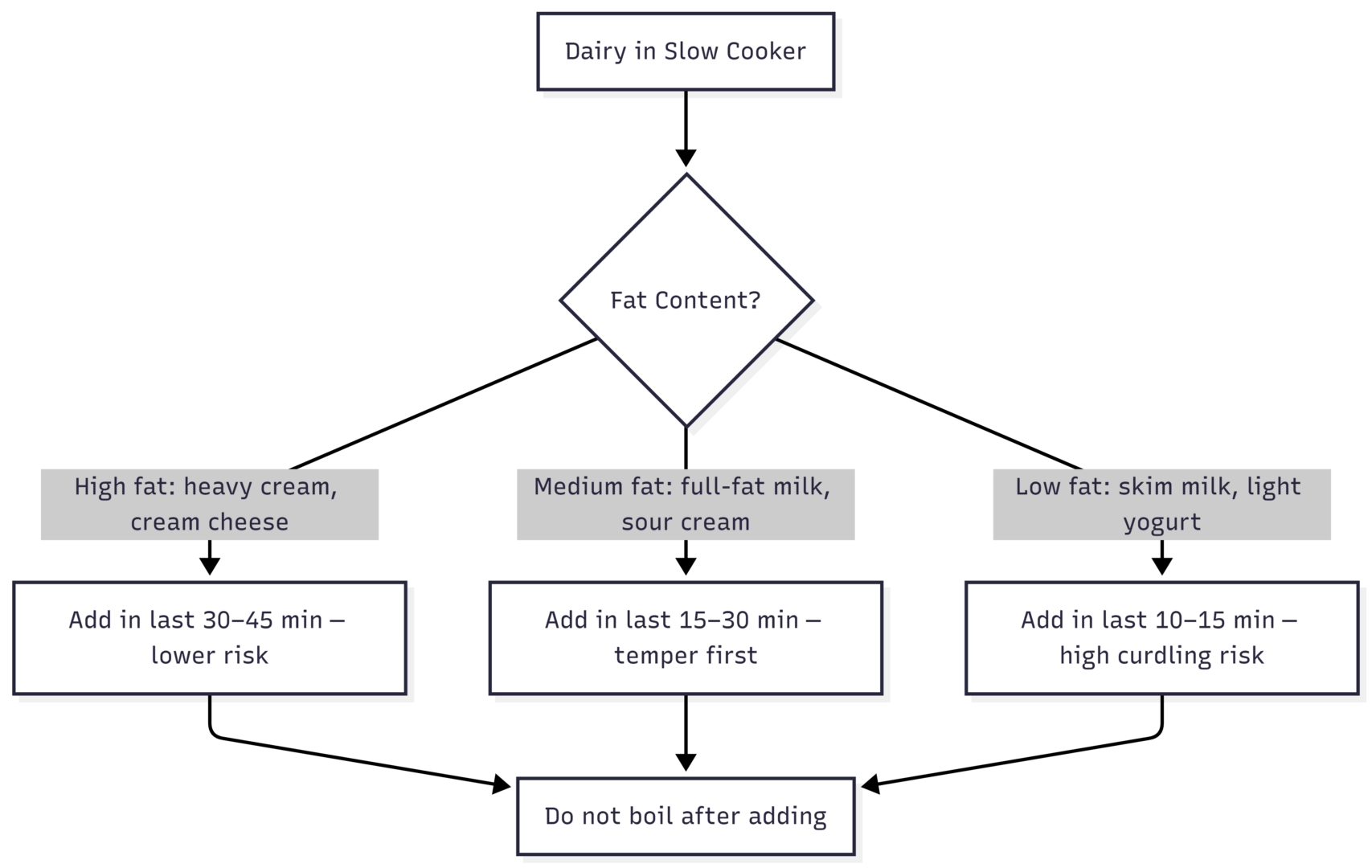
5. How to Prevent Dairy from Curdling
This is the question most slow cooker users struggle with, and the answer is straightforward once you understand the science. Dairy products — milk, cream, sour cream, yogurt, and cheese — are emulsions of water, fat, and proteins. Prolonged heat, salt, and acids all trigger protein coagulation, which is what causes the grainy, separated texture that ruins creamy soups and sauces.
The Rules for Dairy in a Slow Cooker:
- Add milk, light cream, sour cream, and yogurt during the last 15–30 minutes of cooking
- Add heavy cream during the last 30–45 minutes
- Add shredded cheese in the final 15 minutes, stirring until melted
- Temper cold dairy before adding: stir several spoonfuls of hot cooking liquid into the cold dairy first, then add the warmed mixture back into the pot
- Never let the dish boil after dairy has been added
- Stabilize with starch: whisk a teaspoon of cornstarch or flour into the dairy before adding it
| Dairy Type | When to Add | Risk Level | Tips |
|---|---|---|---|
| Heavy cream | Last 30–45 min | Low | High fat = more stable |
| Full-fat milk | Last 15–20 min | Medium | Temper before adding |
| Sour cream | Last 15 min | Medium-High | Always temper; add off-heat |
| Yogurt | Last 15 min | High | Full-fat; temper required |
| Shredded cheese | Last 10–15 min | Medium | Add gradually, stir continuously |
| Cream cheese | Last 30 min | Low | Cubed; blends into sauce smoothly |
| Evaporated milk | Last 30 min | Low | Most heat-stable option |
| Condensed soup (cream of X) | Start | Very Low | Pre-stabilized; safe from the beginning |
If you prefer a true “dump and go” approach, use cream of mushroom soup, cream of chicken soup, or cream cheese as your dairy base — these are pre-stabilized and can go in at the start without curdling.
6. Do You Need to Brown Meat First?
Technically, no — browning is not required for food safety. But skipping it costs you flavor. Browning triggers the Maillard reaction, a chemical process that creates hundreds of new flavor compounds on the surface of the meat. Without it, slow-cooked meat can taste one-dimensional and have a gray, unappealing color.
For dishes where appearance and depth of flavor matter — pot roast, beef stew, lamb shanks — take 5 minutes to sear the meat in a hot pan before it goes in the cooker. For dishes with a lot of aromatics, spices, or sauce, like pulled pork in BBQ sauce or chicken tikka masala, you can often skip browning and not notice much difference.
7. When Should You Add Vegetables?
Vegetables fall into two categories for slow cooker purposes: dense root vegetables that need the full cook time, and delicate vegetables that will turn to mush if cooked for hours.
| Vegetable Type | When to Add | Examples |
|---|---|---|
| Dense root vegetables | Beginning | Potatoes, carrots, parsnips, beets, turnips |
| Sturdy aromatics | Beginning | Onions, celery, garlic |
| Squash | Middle (last 2–3 hours) | Butternut, acorn squash |
| Delicate vegetables | Last 30–45 min | Zucchini, peas, corn, green beans |
| Leafy greens | Last 15 min | Spinach, kale, chard |
| Fresh herbs | Last 5–10 min | Parsley, basil, cilantro, dill |
| Dried herbs and spices | Beginning | Oregano, thyme, cumin, paprika |
Layering order matters: Place root vegetables on the bottom and sides of the crock (they cook slower and benefit from direct contact with the heat source), then add meat on top. Add liquids last.
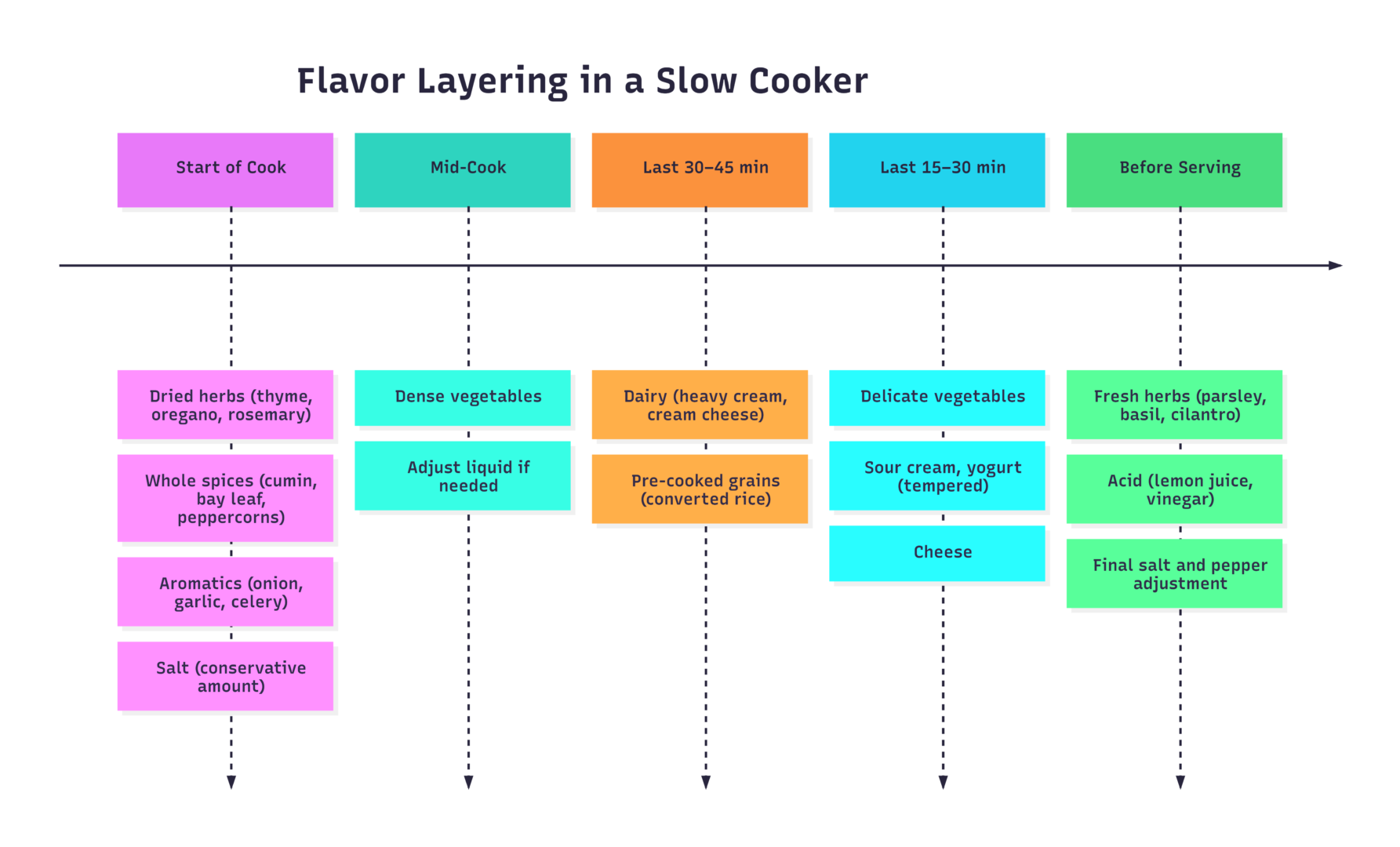
8. Early vs. Late Seasoning: What’s the Difference?
Seasoning timing significantly affects the final flavor of a dish. This is an area where many recipes give vague guidance, but the principle is clear:
Add at the beginning: Dried herbs, whole spices, bay leaves, garlic, onion, and salt. These need time and heat to bloom and infuse the liquid. Adding them early extracts their essential oils and builds the flavor base of the dish.
Add at the end: Fresh herbs, citrus juice, vinegar, fish sauce, and fresh pepper. These are volatile aromatics — their flavor compounds evaporate quickly under heat. Adding them at the start means they’ll be completely cooked off by the time the dish is done. Fresh parsley, basil, cilantro, a squeeze of lemon, or a splash of balsamic vinegar added in the last 10–15 minutes brightens and lifts the entire dish.
Adjust salt at the end. Because slow cooker liquid concentrates as it cooks, dishes can become saltier than expected. Season conservatively at the start and taste and adjust before serving.
9. How Do You Stop Food from Getting Mushy?
Mushy food is usually the result of overcooking, wrong ingredient order, or too much liquid. The fixes:
- Follow the layering order — dense vegetables on the bottom, delicate ones added late
- Add pasta and rice separately. Cook pasta according to package directions and stir it in just before serving. For rice, use converted (parboiled) rice if cooking all day; add instant rice in the last 30 minutes
- Don’t overfill — the crock should be half to two-thirds full. Under-filled cookers run too hot; over-filled ones don’t circulate heat properly
- Use the correct setting — High for too long on boneless chicken breast or fish will overcook them quickly
- Check doneness 30–60 minutes before the recipe’s stated end time, especially with your first attempt at a new recipe
10. What Size Slow Cooker Do You Actually Need?
Slow cooker size is one of the most practical purchasing decisions you’ll make. The wrong size leads to either undercooked food (too big, not full enough) or overflow (too small).
| Size | Capacity | Best For | Price Range |
|---|---|---|---|
| Small | 1.5–3 qt | 1–2 people, dips, sides, desserts | $20–$45 |
| Medium | 4–5 qt | 3–4 people, everyday family meals | $35–$80 |
| Large | 6–7 qt | 5–6 people, whole chickens, roasts | $50–$120 |
| Extra-Large | 8–10 qt | Crowds, batch cooking, meal prep | $70–$180 |
For most households of 2–4 people, a 5–6 quart model is the most versatile choice. It’s large enough for a whole chicken or a pot roast, but not so large that a standard soup recipe looks lost in the bottom. If you batch cook or regularly feed a crowd, consider a 7–8 quart model.
Programmable vs. manual: Programmable models add $20–$50 to the price but include automatic shift to “warm” once cooking completes — a worthwhile feature if you’re away from home during cooking.
Common Slow Cooker Mistakes and Fixes
| Mistake | What Happens | Fix |
|---|---|---|
| Opening the lid repeatedly | Adds 20–30 min per opening | Only open when necessary |
| Using frozen meat | Bacterial danger zone risk | Thaw completely first |
| Adding dairy too early | Curdling and separation | Add in last 15–30 min |
| Overfilling the crock | Uneven cooking, potential overflow | Keep between ½ and ⅔ full |
| Reheating leftovers in slow cooker | Too slow to reach 165°F safely | Use microwave or stovetop |
| Too much liquid | Watery, diluted flavor | Use ½–1 cup for most dishes |
| Adding fresh herbs too early | Flavor completely cooked off | Add in last 5–10 min |
| Cooking on Warm from the start | Never reaches safe temperature | Start on Low or High |
Final Takeaway
A slow cooker rewards patience and proper technique. The biggest wins come from understanding three things: timing (when each ingredient goes in), temperature (the distinction between Low, High, and Warm), and dairy handling (always late, always tempered). Master those three areas and the slow cooker becomes one of the most reliable tools in your kitchen — capable of producing deeply flavorful, restaurant-quality results with minimal active effort.
The most common frustrations — curdled dairy, mushy vegetables, watery sauces, and dry meat — all have straightforward solutions once you understand why they happen. Use the tables and timing guide above as a reference for your next recipe, and you’ll avoid the mistakes that trip up most home cooks.
Please share this Top 10 slow cooker questions, answered with your friends and do a comment below about your feedback.
We will meet you on next article.
Until you can read, 5 Benefits of Cooking with Low Heat