5 Benefits of Cooking with Low Heat
Low heat cooking is one of the oldest and most effective culinary techniques known to humanity. Evidence from archaeological findings points to ancient civilizations using underground ovens and slow-fire pits long before the modern kitchen existed. Today, the science behind why “low and slow” produces superior results is well documented—and it goes far deeper than simply avoiding burnt food.
Whether you’re braising a tough cut of beef, simmering a pot of soup, or gently steaming vegetables, cooking at lower temperatures fundamentally changes how ingredients behave, how nutrients are preserved, and how flavors develop. This guide breaks down exactly what happens when you turn the heat down—and why the results are almost always worth it.
The Science Behind Low Heat Cooking
Before diving into the benefits, it helps to understand what heat actually does to food at the molecular level. When food is exposed to high temperatures, several things happen simultaneously: proteins denature and tighten, moisture evaporates rapidly, natural sugars caramelize or burn, and volatile aromatic compounds—responsible for flavor and aroma—escape into the air rather than staying in the dish.
Low heat slows all of these processes down. The result is more controlled chemistry, better texture, and a final product that retains more of what made the raw ingredients valuable in the first place.
How Low Heat Cooking Compares to High Heat
| Feature | High Heat (Fast Cooking) | Low Heat (Slow Cooking) |
|---|---|---|
| Texture | Crispy/charred surface, often tough inside | Tender and soft throughout |
| Moisture | Evaporates quickly, food dries out | Retained, dishes stay juicy and rich |
| Flavor | Sharp, sometimes bitter or charred | Deep, complex, fully melded |
| Nutrient Retention | Significant loss, especially heat-sensitive vitamins | Higher preservation of vitamins and antioxidants |
| Acrylamide Formation | High risk with starchy foods above 120°C/248°F | Minimal to none |
| Best For | Steaks, stir-fry, searing, quick sautéing | Stews, braises, roasts, soups, slow cooker meals |
| Collagen Breakdown | Insufficient time, meat stays tough | Fully converts to gelatin—creates tenderness |
Benefit 1: Enhanced Texture and Tenderness
The single most dramatic difference between low heat and high heat cooking is what happens to tough proteins and connective tissue.
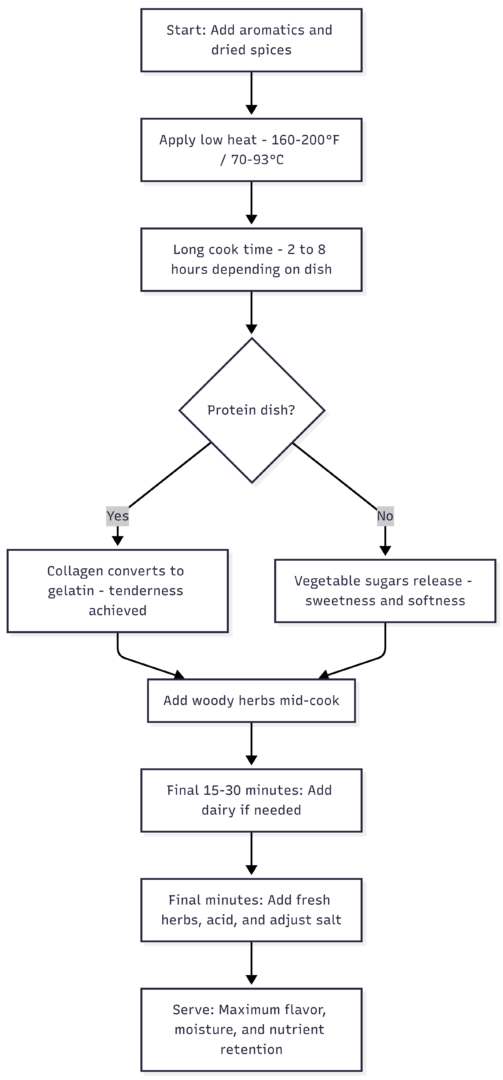
Meat contains collagen—a fibrous protein that makes up tendons, cartilage, and connective tissue. At high temperatures, proteins in meat tighten and shrink quickly, squeezing out moisture and turning the flesh dry and rubbery. But at sustained low temperatures—around 160°F (70°C)—collagen undergoes a slow conversion into gelatin. That gelatin is what gives slow-cooked dishes their signature silky, rich mouthfeel. It coats every bite, adding body and depth that simply cannot be replicated by a fast cook at high heat.
This is why cuts like beef brisket, pork shoulder, lamb shank, and oxtail are nearly always cooked low and slow. At high heat, these same cuts would be nearly inedible. With time and gentle warmth, they become fork-tender and deeply flavorful.
The principle applies to vegetables, too. Hard root vegetables like carrots, parsnips, and sweet potatoes cooked slowly soften evenly from the outside in. High heat causes the exterior to overcook before the interior reaches the right texture. Low heat ensures uniform softening—no mushy edges, no raw cores.
Benefit 2: Deeper, More Complex Flavor Development
Flavor is chemistry. And the chemical reactions that produce the most satisfying, layered flavors take time.
Flavor Fusion Through Long Cook Times
When multiple ingredients—proteins, fats, aromatics, herbs, spices, and liquids—spend hours together at a low temperature, their individual flavor compounds diffuse and interact. Aromatics like onion, garlic, and celery break down and release their sugars and sulfur compounds slowly, gradually building a base of savory sweetness. Spices and herbs infuse the cooking liquid over hours rather than minutes. Fat dissolves slowly and carries fat-soluble flavor molecules throughout the dish.
At high heat, this process is truncated. Individual flavors stay distinct, sometimes sharp or raw. With low heat, the boundaries blur in the best possible way—what you end up with is a unified, harmonious flavor profile rather than a collection of separate tastes.
Natural Sweetness in Vegetables
Slow cooking causes cell walls in vegetables to break down gradually, releasing natural sugars. Onions cooked slowly for 45 minutes develop a sweetness that no amount of high-heat cooking can replicate. Carrots, beets, and winter squash all become noticeably sweeter and more aromatic under low, sustained heat. The sugars caramelize gently rather than burning, adding depth without bitterness.
The Role of Seasoning Timing in Low Heat Cooking
One nuance that matters significantly in low heat cooking is when you add your seasoning. Early seasoning vs. late seasoning produce distinctly different results:
- Early seasoning (start of cook): Salt added at the beginning draws moisture from ingredients through osmosis, which then reabsorbs back into the food carrying dissolved flavor compounds. This deepens the overall seasoning of the dish but can cause herbs and spices to lose their volatility over long cook times.
- Late seasoning (end of cook): Adding fresh herbs, acid (lemon juice, vinegar), and final salt adjustments at the end of cooking preserves brightness and sharpness. These ingredients provide contrast to the deep, rounded flavors that have developed over hours.
The best approach is flavor layering: build foundational flavors early (aromatics, dried spices, fats), and add finishing elements at the end (fresh herbs, acid, dairy, and final salt adjustment). This two-stage approach ensures both depth and brightness in the final dish.
Herbs vs. Spices: Timing Matters
| Ingredient Type | When to Add | Why |
|---|---|---|
| Dried spices (cumin, paprika, coriander) | Beginning of cook | Need time and heat to bloom and release fat-soluble flavor compounds |
| Woody herbs (thyme, rosemary, bay leaf) | Beginning to middle of cook | Release flavor slowly; work well in long braises |
| Delicate fresh herbs (parsley, cilantro, basil, chives) | Last 5–10 minutes or at serving | Volatile oils evaporate quickly; long cooking destroys flavor and color |
| Acid (lemon juice, vinegar) | End of cook | Brightens and lifts the final dish; loses impact if cooked too long |
| Dairy (cream, yogurt, sour cream) | Last 15–30 minutes | Prevents curdling; adds richness without separating |
This timing framework—often called flavor layering—is the difference between a flat-tasting slow-cooked dish and one that has dimension, contrast, and vibrancy.
Benefit 3: Superior Moisture and Juice Retention
Moisture is one of the most important factors in how satisfying a dish feels to eat. Low heat is profoundly better at preserving it.
At high temperatures, water inside food reaches boiling point and vaporizes rapidly. Roasting a chicken at 450°F (230°C) will give you crispy skin, but unless you’re very careful, the breast meat will lose significant moisture in minutes. A chicken cooked at 300°F (149°C) for a longer period retains far more internal moisture while still reaching safe serving temperatures.
In liquid-based dishes—soups, stews, braises—the same principle applies. Boiling at a rolling boil forces moisture to evaporate and can make broth cloudy and reduced too fast. A gentle simmer keeps the liquid stable, allowing flavors to concentrate gradually without stripping the dish of the liquid volume needed to keep everything tender and saucy.
For meat cooked in dry heat (roasting, slow cooker), the low temperature ensures that juices released from muscle fibers don’t boil away but stay present in the pan or slow cooker, either reabsorbing into the meat or forming the foundation of a sauce.
Benefit 4: Better Nutrient Retention
Cooking inevitably changes the nutritional profile of food, but the degree of change depends heavily on temperature and cooking time.
Heat-sensitive vitamins—particularly Vitamin C, Vitamin B1 (thiamine), and folate—degrade rapidly at high temperatures. Studies have consistently shown that vegetables cooked at lower temperatures retain higher concentrations of these nutrients compared to those boiled rapidly or exposed to sustained high heat.
Phytonutrients—beneficial plant compounds like polyphenols and carotenoids—follow similar patterns. Many are sensitive to excessive heat, and prolonged high-temperature cooking accelerates their degradation. Low heat allows food to be thoroughly cooked without the extreme temperatures that strip these compounds from the food.
There is nuance here: some nutrients, like lycopene in tomatoes, actually become more bioavailable with cooking. The key is moderation—enough heat to break down cell walls and release the compound, but not so much that it degrades entirely. Low heat cooking occupies this sweet spot far more reliably than high-heat methods.
Low heat cooking also generally results in less water-based nutrient loss. When vegetables are boiled at a rolling boil in large volumes of water, water-soluble vitamins leach out into the cooking water. Steaming and slow-simmering in smaller amounts of liquid minimize this effect significantly.
Benefit 5: Safer Food Chemistry — Reduced Acrylamide Formation
This benefit is less commonly discussed but scientifically significant: cooking at lower temperatures dramatically reduces the formation of acrylamide, a chemical compound classified as a probable human carcinogen.
Acrylamide forms when starchy foods—potatoes, bread, cereals, coffee—are cooked at temperatures above approximately 120°C (248°F). The Maillard reaction, responsible for browning and the associated flavors we associate with roasted or fried foods, also drives acrylamide formation at the high end of the temperature spectrum.
At low temperatures, this reaction either doesn’t occur or occurs at a significantly slower rate. Slow-cooked dishes that don’t involve surface browning at high heat—stews, braises, poached dishes, steamed vegetables—contain negligible amounts of acrylamide compared to fried or heavily roasted equivalents.
For everyday cooking, this translates to a simple principle: if you’re regularly eating slow-cooked meals prepared at low temperatures, you’re reducing your cumulative exposure to one of the more well-documented dietary sources of acrylamide.
How Temperature Affects Taste Perception
There is another dimension to low heat cooking that is often overlooked: temperature affects not just how food is cooked, but how it is tasted.
Research by Karel Talavera Pérez, professor of molecular and cellular medicine at the University of Leuven, has demonstrated that taste perception decreases when food temperature rises above 35°C (95°F). At very high temperatures, a burning sensation may effectively mask taste signals. Meanwhile, the taste receptor TRPM5—responsible for detecting sweet, bitter, and umami—sends stronger electrical signals to the brain at warm rather than piping hot temperatures, which is one reason ice cream tastes sweeter as it warms slightly in the mouth.
Low heat cooking also preserves more volatile aromatic compounds in finished dishes. Aroma is responsible for a significant proportion of what we perceive as flavor. When food is aggressively boiled or subjected to very high heat, aromatic molecules evaporate into the air before the food reaches the table. Gentle, low heat keeps more of these compounds dissolved in the cooking liquid or retained in the food itself—meaning the dish smells and tastes more intensely of itself when you eat it.
Low Heat Cooking: A Practical Framework
Low Heat Temperature Reference Guide
| Cooking Method | Temperature Range | Ideal For |
|---|---|---|
| Slow cooker (Low setting) | 190–200°F / 87–93°C | Braises, stews, soups, pulled meats |
| Slow cooker (High setting) | 280–300°F / 138–149°C | Faster braises, bean dishes |
| Oven braising | 275–325°F / 135–163°C | Roasts, short ribs, lamb shoulder |
| Gentle simmering (stovetop) | 180–190°F / 82–88°C | Stocks, soups, poaching |
| Steaming | 212°F / 100°C | Vegetables, fish, dumplings |
| Sous vide | 130–185°F / 54–85°C | Precision protein cooking |
Final Thoughts
Low heat cooking is not a shortcut—it’s a commitment to quality. By slowing down the process, you give ingredients the time they need to reach their full potential: proteins that melt rather than toughen, vegetables that become sweeter rather than bitter, nutrients that survive the cooking process, and flavors that develop real depth and complexity.
The key discipline is understanding when to add what: dried spices early to bloom in fat, woody herbs mid-cook, and fresh herbs and acid at the very end to preserve their brightness. Dairy goes in last to prevent separation. Salt should be adjusted gradually rather than added all at once.
This approach—patient, layered, and temperature-conscious—produces dishes that are consistently more tender, more nutritious, more flavorful, and safer from a food chemistry standpoint than anything cooked fast and hot. The ancient civilizations who figured this out with nothing more than embers and clay pots were onto something that holds up entirely under modern scientific scrutiny.
Please share this How to Convert Regular Recipes into Slow Cooker Recipes with your friends and do a comment below about your feedback.
We will meet you on next article.
Until you can read, How to Layer Ingredients Properly in a Slow Cooker