10 Food Safety Tips for the Slow Cooker
Slow cookers offer unparalleled convenience for preparing meals with minimal hands-on effort, allowing ingredients to simmer slowly into flavorful dishes. However, their low-temperature cooking method demands strict adherence to food safety practices to avoid bacterial contamination and foodborne illnesses.
This comprehensive guide outlines 10 key food safety tips, drawing from established guidelines to help you use your slow cooker effectively and safely. By following these practices, you can minimize risks associated with pathogens like Salmonella and E. coli, which thrive in the “danger zone” between 40°F and 140°F.
We’ll explore each tip in depth, including preparation, cooking, and storage strategies, along with supporting details on temperature management and equipment testing.
Tip 1: Start with Clean Equipment and Hands
Hygiene forms the foundation of safe slow cooking. Before assembling any recipe, ensure your slow cooker, utensils, cutting boards, and work surfaces are thoroughly cleaned. Wash the ceramic insert and lid with hot, soapy water or in a dishwasher if labeled safe. This step eliminates residual bacteria from previous uses.
Equally important is personal hygiene. Wash your hands for at least 20 seconds with soap and warm water before handling ingredients, after touching raw meat, poultry, or seafood, and periodically during preparation. Cross-contamination can occur easily if hands transfer pathogens from raw foods to ready-to-eat items.
Why is this crucial? Slow cookers heat gradually, giving bacteria time to multiply if introduced early. Starting clean reduces the initial microbial load, allowing the cooking process to effectively destroy any remaining pathogens as temperatures rise. Neglecting this can lead to outbreaks of illnesses like campylobacteriosis, which affects millions annually due to improper handling.
In practice, incorporate this into your routine: Sanitize counters with a food-safe disinfectant after prepping raw ingredients. If preparing ahead, store cut items in sealed containers to maintain cleanliness until cooking begins.
Tip 2: Keep Perishable Ingredients Refrigerated Until Use
Perishable foods, including meat, poultry, dairy, and cut vegetables, should remain in the refrigerator until the moment they’re added to the slow cooker. Bacteria multiply rapidly at room temperature—doubling every 20 minutes in the danger zone—so minimizing exposure is key.
For recipes requiring advance prep, chop vegetables and meat separately and refrigerate them in airtight containers. Avoid leaving ingredients out while you assemble other components. This practice ensures the slow cooker’s gradual heating doesn’t give bacteria a head start.
The science behind this: At temperatures above 40°F, pathogens like Listeria can proliferate, potentially reaching unsafe levels before the cooker hits 140°F. By keeping items cold (below 40°F), you slow bacterial growth, buying time for the cooking process to kill them off.
Apply this tip by planning your workflow: Retrieve items from the fridge one at a time, add them directly to the pot, and start cooking immediately. For busy mornings, prep the night before and store the filled insert in the fridge overnight, then plug it in the next day.
Tip 3: Thaw Meat and Poultry Completely Before Adding
Never place frozen meat or poultry directly into a slow cooker. Thaw them fully in the refrigerator, microwave, or under cold running water (changing the water every 30 minutes). If using the microwave or cold water method, cook immediately after thawing to prevent bacterial growth.
Thawing ensures even cooking, allowing the food to pass quickly through the danger zone. Frozen items can remain in this risky range for hours, fostering bacterial multiplication. Vegetables, however, can be added frozen since they thaw faster and pose lower risks.
This tip is vital because partial thawing can create temperature gradients, where outer layers heat while the core stays cold, ideal for pathogens. Refrigerator thawing is safest, taking 24 hours per 5 pounds of meat, but plan accordingly.
To implement: Label freezer bags with thaw dates and use a dedicated thawing tray in the fridge. For seafood, follow similar rules—thaw safely and add last to avoid overcooking.
Tip 4: Use Separate Cutting Boards to Prevent Cross-Contamination
When prepping ingredients, use separate cutting boards for raw meat, poultry, seafood, and produce. Color-code them (e.g., red for meat, green for veggies) to avoid mix-ups. After use, wash boards with hot, soapy water or sanitize in the dishwasher.
Cross-contamination transfers harmful bacteria from raw proteins to foods eaten raw or cooked minimally, like garnishes. In a slow cooker, where everything simmers together, this can contaminate the entire batch.
Understanding the risk: Raw chicken often harbors Campylobacter, which can spread to vegetables if shared surfaces are used. Preventing this maintains the integrity of your meal’s safety.
Best practice: After cutting raw meat, wash hands, utensils, and boards immediately. Store prepped items separately in the fridge to further reduce risks.
Tip 5: Fill the Slow Cooker Properly for Optimal Heat Transfer
Fill your slow cooker between half and two-thirds full—no more, no less. Overfilling impedes heat circulation, potentially leaving pockets of undercooked food. Underfilling can cause overcooking or drying out, but more critically, it affects temperature consistency.
Proper filling promotes even heat distribution via convection from the liquid and steam. Recipes like soups and stews work best, as high moisture aids in conducting heat.
Why it matters: Inconsistent heating can keep parts of the food in the danger zone longer, allowing bacteria to survive. Most slow cookers (4-6 quarts) handle 2-4 quarts of ingredients optimally—check your model’s manual for specifics.
Tip in action: Measure ingredients to fit the range. For larger cuts, trim to size. If scaling recipes, adjust accordingly to maintain the fill level.
Tip 6: Ensure Adequate Liquid for Heat Conduction
Always include enough liquid—such as broth, water, sauce, or natural juices from ingredients—to cover or nearly cover the contents. This generates steam, which helps raise temperatures quickly and evenly.
Low-moisture recipes risk dry spots where bacteria persist. High-moisture dishes like chilis or braises are ideal for slow cookers.
The rationale: Liquid acts as a heat conductor, ensuring the entire pot reaches above 140°F efficiently. Without it, cooking times extend, heightening contamination risks.
Practical advice: Start with at least 1-2 cups of liquid per recipe, adjusting based on ingredients. For denser meals, add more to compensate.
Tip 7: Keep the Lid On to Maintain Temperature
Resist the urge to lift the lid frequently. Each removal drops the internal temperature by 10-15°F, extending cooking time by up to 30 minutes and risking bacterial growth.
The sealed environment traps heat and steam, essential for safe cooking. Only remove the lid briefly to stir or check doneness near the end.
Importance: Heat loss prolongs the time in the danger zone, where pathogens thrive. Consistent temperature is key to pathogen destruction.
Strategy: Use clear lids for visual checks. For recipes needing stirring, do so minimally and quickly replace the lid.
Tip 8: Verify Safe Internal Temperatures with a Thermometer
Always use a food thermometer to confirm meats and other proteins reach safe internal temperatures. Insert it into the thickest part, avoiding bone or fat.
Safe temperatures vary by food type:
| Food Type | Safe Internal Temperature (°F) | Notes |
|---|---|---|
| Whole cuts of beef, pork, veal, lamb | 145 | Allow 3-minute rest before serving |
| Fish | 145 | Flesh should be opaque |
| Ground meats (beef, pork) | 160 | No rest needed |
| Egg dishes | 160 | Ensure even heating |
| Poultry (whole or ground) | 165 | Check multiple spots |
This is the only reliable way to ensure pathogens are killed, as visual cues like color can mislead.
Why essential: Slow cookers may not heat uniformly, and older models might not reach adequate levels. Testing guarantees safety.
Usage: Invest in a digital instant-read thermometer for accuracy. For large batches, check multiple pieces.
Tip 9: Handle Power Outages Appropriately
If power fails while you’re away, discard the food upon return, even if it appears cooked. Bacteria can multiply unchecked during outages.
If home during the outage and food is fully cooked, consume within two hours or finish cooking via alternative methods (stove, grill). If uncooked, transfer to another heat source immediately.
Risk explanation: Without power, temperatures drop into the danger zone rapidly. Outages longer than two hours are particularly hazardous.
Preparation: Use surge protectors for your slow cooker. For frequent outages, consider models with battery backups or avoid unattended cooking.
Tip 10: Store and Reheat Leftovers Safely
Remove leftovers from the slow cooker within two hours (one hour if above 90°F ambient temperature) and transfer to shallow containers for rapid cooling in the fridge.
Never reheat in the slow cooker—instead, use a stove, microwave, or oven to reach 165°F. Once hot, you can transfer to a preheated slow cooker for keeping warm at 140°F or above.
Proper storage prevents bacterial regrowth. Consume refrigerated leftovers within 3-4 days or freeze for longer.
Significance: Leftovers cool slowly in the pot, staying in the danger zone. Shallow containers (under 2 inches deep) cool faster, reducing risks.
Tips: Divide large portions. Label with dates. For reheating, stir to ensure even temperature.
Preventing Bacterial Growth in Slow Cookers
Slow cookers operate at 170-280°F, but the initial hours are critical as temperatures climb slowly. To mitigate, cut meat and vegetables into smaller, uniform pieces (1-2 inches) for faster heating. This reduces time in the danger zone.
Add vegetables first, as they cook slower than proteins. Prioritize high-moisture recipes to generate steam quickly.
For older models, start on high for the first hour to accelerate heating, then switch to low. This counters potential inefficiencies in heat-up time.
Bacterial prevention also involves avoiding delayed starts—never use timers to begin cooking later, as room-temperature ingredients invite growth.
Testing Your Slow Cooker’s Heating Capacity
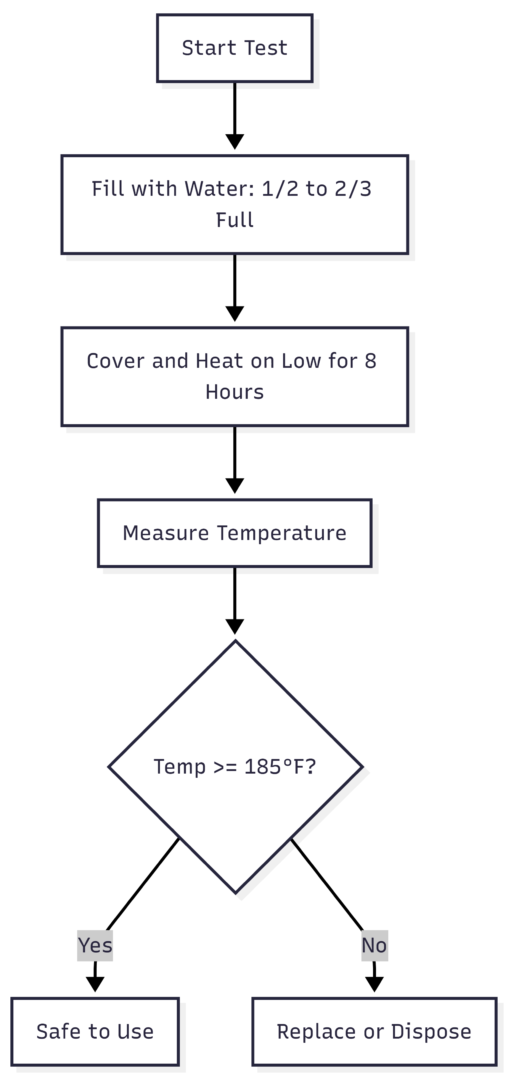
Ensure your slow cooker functions safely by performing a simple test:
- Fill it half to two-thirds with water.
- Cover and heat on low for eight hours.
- Quickly measure the water temperature—it should reach at least 185°F.
If below, the unit may not heat sufficiently, risking undercooking. Replace if under warranty (typically 2 years) or dispose properly.
This test simulates cooking conditions, verifying the appliance keeps food out of the danger zone.
Regular testing, especially for units over two years old, maintains reliability.
Preparing Food for Safe Slow Cooking
Preparation sets the stage for success. Rinse produce under running water before cutting. For meats, select cuts suitable for your cooker’s size—consult the manual.
Add frozen vegetables if needed, but never frozen proteins. Opt for recipes with inherent moisture to aid heating.
Cross-check liquid levels: Too little hinders steam; too much overflows. Aim for balance.
Cooking Practices for Maximum Safety
Position the cooker on a flat, clear surface. Plug directly into an outlet—avoid extensions.
Monitor minimally, but ensure it’s operating. For all-day cooks, low setting is fine if temperatures verify safe.
Large cuts work if sized appropriately, but smaller pieces ensure evenness.
Handling and Storing Leftovers Effectively
Beyond basic storage, cool leftovers quickly by placing containers in an ice bath if needed. Freeze in portions for convenience.
When reheating, bring to a rolling boil on the stove for liquids or use microwave settings that ensure 165°F.
Clean the cooker post-use: Wash insert and lid promptly to prevent bacterial residue.
Benefits of Safe Slow Cooking
Adhering to these tips not only prevents illness but enhances meal quality. Slow cookers tenderize tough cuts efficiently, using less energy than ovens. They’re versatile for year-round use—warming stews in winter or avoiding oven heat in summer.
By integrating safety into your routine, you unlock the full potential of this appliance, creating nutritious, flavorful meals without compromise.
In summary, these 10 tips—cleanliness, refrigeration, thawing, separation, proper filling, liquid adequacy, lid discipline, temperature verification, outage handling, and safe storage—form a robust framework for slow cooker safety. Implement them consistently for peace of mind and delicious results.
Please share this 10 Food Safety Tips for the Slow Cooker with your friends and do a comment below about your feedback.
We will meet you on next article.
Until you can read, Slow Cooker Meal Planning & Prep Tips