How to Convert Regular Recipes into Slow Cooker Recipes
The slow cooker is one of the most underused tools in the modern kitchen — not because it lacks power, but because most home cooks don’t know how to adapt their existing recipes for it. Tossing your favorite stew or braise into a slow cooker without adjustments is a recipe for watery, mushy, or bland results. But with a few targeted changes, almost any recipe that uses low, slow heat can be successfully converted. Here’s everything you need to know.
Which Recipes Convert Best
Not every dish belongs in a slow cooker. The best candidates are those that already rely on extended, low-heat cooking: soups, stews, chili, braised meats, roasts, pulled pork, and casseroles. If a recipe simmers on the stovetop for an hour or more, or bakes low and slow in the oven, it’s almost always a strong candidate for slow cooker conversion.
Dishes that don’t convert well include anything that requires high-heat browning throughout (like a stir-fry), delicate proteins like fish or shrimp that cook in minutes, or baked goods that rely on precise oven heat for structure.
The Conversion Time Chart
The most critical adjustment when converting a recipe is the cooking time. The slow cooker operates at around 210°F on most models — the difference between HIGH and LOW settings is simply how quickly it reaches that temperature, not the final temperature itself.
Use this table as your baseline:
| Original Cook Time (Stovetop/Oven at 350°F) | Slow Cooker LOW | Slow Cooker HIGH |
|---|---|---|
| 15–30 minutes | 4–6 hours | 1.5–2.5 hours |
| 35–45 minutes | 6–8 hours | 3–4 hours |
| 1–3 hours | 8–12 hours | 4–6 hours |
Keep in mind these are guidelines, not guarantees. Every slow cooker performs slightly differently, and recipe variables like the density of vegetables or fat content of meat will affect the final timing. When in doubt, start checking the dish earlier than you think necessary.
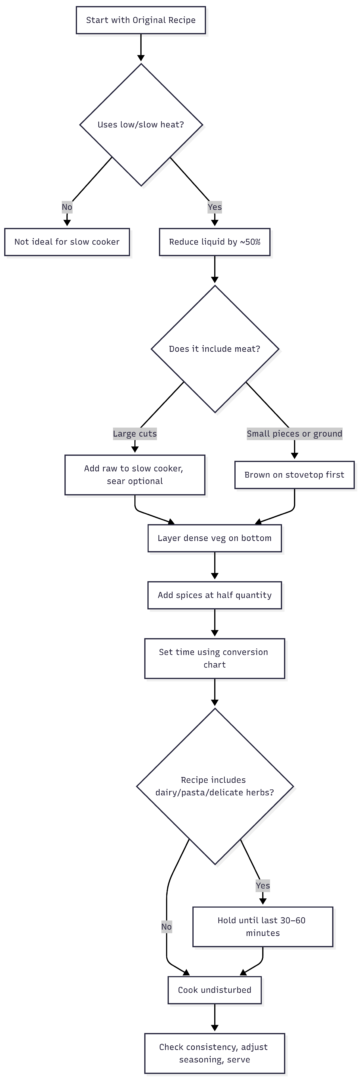
Process Flow: Slow Cooker Conversion Steps
Reduce the Liquid — More Than You Think
This is the single most important rule and the one most often ignored. Slow cookers trap moisture. Unlike stovetop cooking where steam escapes and sauces reduce naturally, the lid of a slow cooker creates a sealed environment where every drop of liquid stays in the pot.
The practical result: if you use the same amount of liquid called for in your original recipe, you’ll end up with soup when you wanted a stew, or a watery braise when you wanted rich, glossy sauce.
The rule: Reduce liquid (stock, wine, water, canned tomatoes) by approximately 50%. For most soups and stews, ½ to 1 cup of added liquid is all you need. The meat and vegetables will release their own juices as they cook, adding to the final volume. Excess liquid will poach or boil the ingredients rather than braise them, resulting in tough meat and mushy vegetables — the opposite of what you want.
If the sauce ends up too thin at the end of cooking, stir in a cornstarch slurry (1 tablespoon cornstarch dissolved in 2 tablespoons cold water), or remove the lid and cook on HIGH for an additional 30 minutes to reduce.
Handling Meat: What to Pre-Cook and What to Skip
Large Cuts of Meat
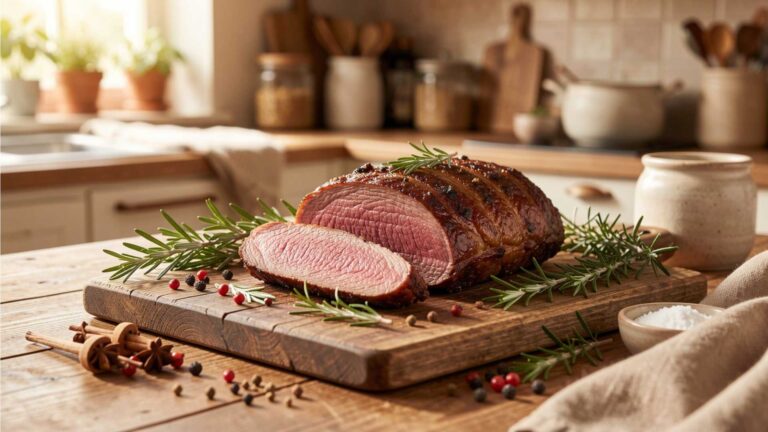
Whole shoulder roasts, chuck roasts, pork butts, and leg of lamb can go straight into the slow cooker raw. These cuts are high in connective tissue, which breaks down slowly under prolonged, gentle heat — producing fork-tender, silky results that high-heat cooking simply cannot replicate. Searing the exterior beforehand in a hot skillet adds a layer of savory, caramelized flavor, but it’s optional if time is short.
Best cuts for slow cooking:
| Protein | Best Cuts |
|---|---|
| Beef | Chuck roast, brisket, short ribs, oxtail |
| Pork | Shoulder, belly, ribs, hocks |
| Chicken | Thighs, drumsticks, whole legs |
| Lamb | Shoulder, shank |
Small Pieces and Ground Meat
Small bite-sized meat pieces and ground meat are different. Without pre-cooking, they develop a grey, steamed texture and release excess fat directly into the dish. Always brown small meat pieces and ground meat on the stovetop before adding them to the slow cooker. Drain excess fat afterward.
Never Cook From Frozen
Frozen ingredients should never go directly into a slow cooker. The appliance takes too long to bring frozen food through the bacterial danger zone (40°F to 140°F), creating a food safety risk. Always thaw meat and vegetables completely before slow cooking.
Vegetable Placement and Timing
Vegetable timing in a slow cooker is a common point of failure. The key insight: dense root vegetables cook more slowly than meat in a slow cooker, which is counterintuitive compared to stovetop cooking.
Vegetable timing guide:
| Vegetable Type | When to Add |
|---|---|
| Potatoes, carrots, parsnips, turnips | Beginning (place on bottom/sides) |
| Winter squash, onions | Beginning |
| Broccoli, cauliflower (shorter cooks) | Beginning; middle for longer cooks |
| Canned beans, corn, peas, spinach, greens | Last 30 minutes |
| Fresh tomatoes | Last 30–60 minutes |
Place root vegetables along the bottom and sides of the slow cooker insert, not on top of the meat. They are denser and require direct contact with the heat source to cook through properly.
Dairy, Pasta, and Delicate Ingredients
Dairy
Milk, cream, sour cream, yogurt, and most cheeses cannot withstand hours of slow cooker heat. They will curdle, separate, or develop an unpleasant grainy texture. Add all dairy products in the final 30 to 60 minutes of cooking, stirring gently to incorporate.
Pasta and Rice
Pasta becomes mushy and disintegrates if added too early. Cook pasta separately on the stovetop and stir it into the finished dish just before serving. If you must add pasta to the slow cooker directly, add it only during the last 30 minutes, and add it already partially cooked (al dente).
Rice can be added directly but requires adequate liquid — roughly 1 cup of liquid per ½ cup of dry rice — and should be added in the last 2 hours on LOW or 1 hour on HIGH.
Herbs and Spices
Dried herbs become muted and sometimes bitter after prolonged slow cooking. Start with half the amount called for in your original recipe. Taste near the end of cooking and adjust. Fresh herbs and aromatics like parsley, cilantro, basil, and chives should be added right before serving to preserve their brightness. Robust fresh herbs like rosemary and thyme can be added at the start.
Onions and Garlic: To Pre-Cook or Not
Onions and garlic cooked in a slow cooker without any pre-cooking can sometimes produce a sharp, raw flavor — especially in shorter-cook dishes. Sautéing them briefly in a skillet before adding them to the pot develops a sweeter, more rounded flavor and improves the overall depth of the dish. It’s not mandatory, but it makes a noticeable difference, particularly in dishes cooking for under 6 hours.
HIGH vs. LOW: Which Setting Should You Choose?
Both settings ultimately bring the slow cooker to the same temperature. The difference is the ramp-up time. LOW takes longer to reach operating temperature; HIGH gets there faster. What drives your choice should be time, not the end temperature.
- Choose LOW for long-cook dishes (8–12 hours): tough meat braises, all-day chili, bone-in roasts
- Choose HIGH for shorter dishes (3–6 hours): soups, chicken dishes, vegetarian meals, casseroles
If you need to switch between settings mid-cook, 1 hour on HIGH is roughly equivalent to 2–2.5 hours on LOW.
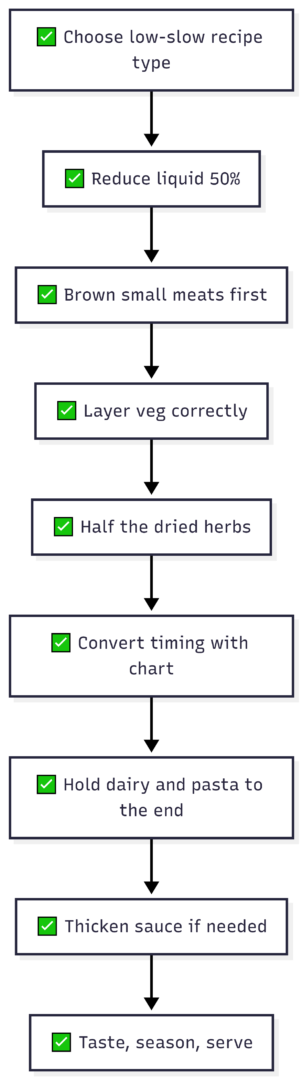
Quick Reference: Full Conversion Checklist
Common Mistakes to Avoid
Lifting the lid: Every time you remove the lid, the slow cooker loses 15–20 minutes of accumulated heat. Resist the urge to check constantly.
Overfilling: Fill the slow cooker no more than two-thirds full. Overfilling leads to uneven cooking and potential overflow.
Using boneless, lean cuts: These dry out and become stringy. Save lean proteins (chicken breast, pork loin, fish) for stovetop or oven cooking.
Adding thickeners too early: Flour and cornstarch can break down over long cook times. Add them in the final 30–60 minutes, or thicken the sauce after cooking on the stovetop.
Final Takeaway
Converting a recipe for the slow cooker comes down to a handful of principles: cut the liquid, respect the timing chart, prep your meat appropriately, and hold delicate ingredients until the end. Once you internalize these rules, adapting almost any low-and-slow recipe becomes straightforward. The reward is a cooking method that works while you don’t — delivering deeply flavored, tender results with minimal active effort.
Please share this How to Convert Regular Recipes into Slow Cooker Recipes with your friends and do a comment below about your feedback.
We will meet you on next article.
Until you can read, How to Clean and Maintain Your Slow Cooker