Any tips to help slow cooker food retain seasoning?
If your slow cooker meals consistently taste bland—even after doubling the seasoning—you are not using the wrong spices. You are adding them at the wrong time. A slow cooker is a sealed, moist, low-heat environment that behaves nothing like a frying pan or oven. Volatile aromatic compounds evaporate over hours, salt dilutes into accumulated liquid, and delicate herbs turn to tasteless mush. The answer is not more seasoning. It is smarter, layered seasoning.
This guide covers every stage: which ingredients to add early versus late, how to layer flavor systematically, how to build richness without dumping in extra salt, and how to rescue a finished dish that still tastes flat.
Why Slow Cookers Destroy Flavor
Understanding the problem is half the solution. A conventional oven allows steam to escape, concentrating flavors as liquid reduces. A slow cooker traps everything under its lid. Over six to ten hours, the following happens:
- Salt dilutes. As meat and vegetables release moisture, liquid volume increases and salt concentration drops, making the dish taste blander than it did raw.
- Volatile aromatics escape or degrade. The fragrant compounds in garlic, onion, and most dried herbs are heat-sensitive. Extended heat breaks them down long before the dish is ready to serve.
- Delicate herbs turn bitter. Fresh soft herbs like basil, parsley, and cilantro contain chlorophyll and tender oils. Hours of heat turns them brown, limp, and either flavorless or faintly bitter.
- Chili heat multiplies. Capsaicin, the compound responsible for heat in chilies, does not degrade with prolonged cooking—it can actually concentrate. A dish that starts mildly spicy can become aggressively hot by the end.
“The slow cooker is not a set-and-forget machine for seasoning. It is a set-and-layer machine. The cooks who get great results treat it like a recipe with three distinct seasoning phases.”
The Three-Phase Layering System
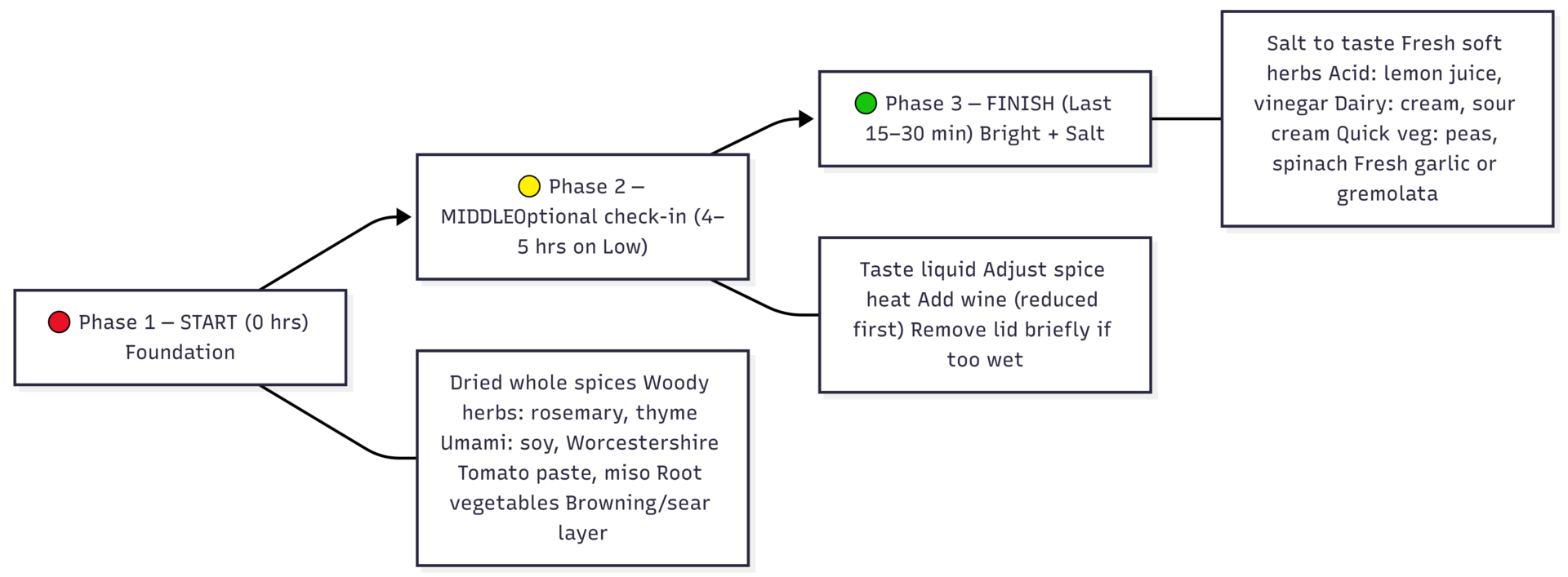
Every well-seasoned slow cooker dish follows a three-phase structure. Think of it as building a flavor foundation at the start, developing the middle, and finishing bright at the end.
Phase 1 — The Foundation (Added at the Start)
Robust, fat-soluble flavor compounds need time to bloom and infuse the cooking liquid. Woody dried herbs, whole spices, and umami-rich condiments go in at the beginning. They are built for long, slow heat.
Browning your meat before it enters the slow cooker belongs in this phase too. The Maillard reaction creates hundreds of flavor compounds on the crust of the meat that do not exist in raw protein. A two-minute sear per side is not optional for flavor—it is foundational. Deglaze the pan with a splash of broth or wine and pour those caramelized bits into the slow cooker as well.
Phase 2 — The Mid-Cook Check (Optional)
Around the halfway point, lift the lid quickly. Taste the liquid. If chili heat is building too fast, add a small amount of dairy or a pinch of sugar to balance. If you are using wine, always reduce it first in a separate pan until the volume halves before adding—raw alcohol will not cook off in a sealed slow cooker and will leave a sharp, unpleasant edge.
Phase 3 — The Finish (Last 15–30 Minutes)
This is where all brightness goes. Salt, acid, fresh herbs, dairy, and any quick-cooking vegetables are added here. Tasting at this stage is not optional—it is the single most important act in slow cooker cooking. A pinch more salt, a squeeze of lemon juice, or a handful of fresh parsley can transform a flat dish into a deeply satisfying one.
Herbs vs. Spices: A Timing Reference
The most common mistake is treating all herbs and spices as interchangeable. They behave completely differently under heat. The rule is simple: dried and woody go early, fresh and delicate go late.
| Ingredient | Type | When to Add | Why |
|---|---|---|---|
| Rosemary, thyme, bay leaf | Dried / woody herb | Early | Woody stems slowly release oils; need long heat |
| Dried oregano, marjoram | Dried herb | Early | Dried cell walls release slowly over hours |
| Cumin, coriander seeds | Whole spice | Early | Fat-soluble, requires sustained heat to bloom |
| Smoked paprika, turmeric | Ground spice | Early | Colors and infuses liquid throughout cooking |
| Garlic powder, onion powder | Dried aromatics | Early | Infuses base liquid from the start |
| Mild chili powder | Ground spice | Early | Distributes flavor, monitor heat buildup |
| Hot chili flakes / cayenne | Heat spice | Late | Capsaicin concentrates over time; add to taste at end |
| Fresh basil, cilantro, parsley | Soft fresh herb | Late | Oils destroyed by heat; adds brightness only when fresh |
| Lemon juice, lime juice | Acid / bright | Late | Acidity dissipates and tastes flat after hours of heat |
| Salt (final seasoning) | Mineral | Late | Liquid volume increases; salt from taste, not recipe |
| Fresh mint | Delicate herb | Late | Turns dark and medicinal under heat |
| Raw alcohol (wine/beer) | Liquid flavor | Pre-reduce | Alcohol does not cook off in sealed pot; reduce first |
Building Flavor Without More Salt
Many people try to solve blandness by adding more salt. A better approach is to build depth through umami, fat, and acid—three flavor dimensions that amplify the perception of seasoning without increasing sodium.
Umami-Rich Ingredients
Umami is the savory, mouth-coating quality that makes a dish feel complete. It comes from glutamates naturally present in certain foods. Adding even a small amount to the slow cooker at the start dramatically raises the overall flavor floor of the dish.
Top Umami Boosters for the Slow Cooker
- Worcestershire sauce — 1–2 tsp; excellent for beef and dark meat chicken
- Soy sauce or tamari — 1 tbsp; amplifies tomato and vegetable dishes
- Tomato paste — 1–2 tbsp; adds body and sweetness, not just tomato flavor
- Miso paste — 1 tbsp stirred in at the end; light miso for chicken, dark for beef
- Fish sauce — ½–1 tsp; undetectable as fish, adds deep savory roundness
- Bone broth — Use in place of water; gelatin and minerals add richness and body
- Dried mushrooms — A small handful, added early; reconstitute and infuse the liquid
The Role of Fat
Fat carries flavor. Marbled cuts of meat—chuck roast, pork shoulder, bone-in chicken thighs—release fat as they cook, which then coats every element in the pot and carries seasoning with it. Lean cuts like boneless chicken breast or pork loin have very little fat to do this work, which is why they frequently taste bland even when well-seasoned. If you are committed to lean cuts, add a tablespoon of butter or olive oil to compensate.
Using Broth Instead of Water
Water has no flavor. Every tablespoon of liquid you add is also an opportunity to add flavor. Replace water with bone broth, chicken stock, beef stock, or for lighter dishes, vegetable broth. If you want a quick shortcut without making stock from scratch, dissolve a good-quality stock cube or a teaspoon of Better Than Bouillon into warm water before adding it to the pot.
Marinating Overnight
Seasoning placed on raw meat sits on the surface. Overnight marination drives those flavors deeper into the protein through osmosis. Dry-brine by rubbing salt, pepper, and your chosen spices directly onto the meat and refrigerating uncovered for 8–24 hours before cooking. The result is flavor that comes from inside the meat, not just its exterior.
Troubleshooting: Fixing Common Slow Cooker Seasoning Problems
- Problem: Tastes Bland or Flat
- Add a squeeze of lemon juice or a splash of white wine vinegar. Acid “wakes up” dormant flavors faster than more salt. Then taste, and add salt if still needed.
- Problem: Too Watery / Flavors Diluted
- Remove the lid and cook on High for the final 30–60 minutes to let liquid reduce. Alternatively, ladle out excess liquid into a saucepan, reduce it rapidly on the stove, and pour it back.
- Problem: Too Salty
- Add a small amount of dairy (cream or plain yogurt), a pinch of sugar, or more unsalted broth. A raw potato added and cooked for 20 minutes can also absorb excess salt—remove before serving.
- Problem: Too Spicy
- Add dairy (yogurt, cream, coconut milk), a pinch of sugar, or more unsalted base liquid. Acidity can intensify heat, so hold back on lemon or vinegar until heat is balanced.
- Problem: Herb Flavor Disappeared
- Add a fresh hit of the same herb at serving time—fresh thyme, a rosemary sprig stripped and chopped, or a parsley gremolata. This restores the aroma the long cook destroyed.
- Problem: Meat Tastes Bland Throughout
- The fix is before the next cook: dry-brine the meat overnight with salt and spices, and always sear it. No surface treatment during the slow cook can penetrate flavor the way marination does.
The Gremolata Finish
One of the most effective finishing techniques in professional slow cooker cooking is the gremolata—a rough mix of finely chopped fresh parsley, minced garlic, and lemon zest, scattered over the dish just before serving. It costs almost nothing in prep time, uses three ingredients that are always on hand, and delivers an enormous burst of brightness and freshness that cuts through the richness of a long-cooked dish.
The same principle applies to any combination of fresh herb, raw garlic or shallot, and citrus zest. A cilantro-lime version works on chicken and pork. A mint-and-lemon version transforms lamb. A basil-and-orange version elevates tomato-based stews. Think of it as the final tuning of an instrument—the dish is technically ready, but this last step makes it sing.
Seasoning Ratio Reference
| Protein (per lb / 450g) | Salt (dry-brine) | Core Spice Blend | Umami Booster | Recommended Finishing Acid |
|---|---|---|---|---|
| Beef (chuck, brisket) | ¾ tsp kosher salt | Black pepper, smoked paprika, garlic powder | Worcestershire sauce, beef bone broth | Red wine vinegar or balsamic |
| Pork (shoulder, ribs) | ¾ tsp kosher salt | Cumin, coriander, oregano, brown sugar | Soy sauce, tomato paste | Apple cider vinegar |
| Chicken (thighs, bone-in) | ½ tsp kosher salt | Thyme, rosemary, garlic, onion powder | Chicken bone broth, miso | Lemon juice or white wine vinegar |
| Lamb (shoulder, shanks) | ¾ tsp kosher salt | Cumin, cinnamon, coriander, bay leaf | Tomato paste, Worcestershire | Lemon juice + fresh mint |
| Vegetables / legumes | ½ tsp kosher salt | Turmeric, cumin, smoked paprika | Soy sauce, dried mushrooms, miso | Lemon juice or sherry vinegar |
Quick-Reference Summary
The Slow Cooker Seasoning Rules
- Always sear meat first. Two minutes per side builds a flavor crust that no amount of added seasoning can replicate.
- Swap water for broth. Every drop of liquid is a seasoning opportunity. Bone broth, stock, or reduced wine beats water every time.
- Add robust spices and woody herbs at the start. They need hours to bloom. Dried oregano, thyme, rosemary, bay, cumin, paprika, turmeric—all go in early.
- Hold delicate ingredients until the last 30 minutes. Fresh herbs, lemon juice, vinegar, dairy, and salt to final taste all go in at the finish.
- Build umami, not just salt. A tablespoon of soy sauce, Worcestershire, or tomato paste adds depth that salt alone cannot provide.
- Reduce wine before adding it. Raw alcohol trapped under the lid creates a harsh, unpleasant edge. Halve the volume in a pan first.
- Taste before serving and adjust. Add acid first (lemon, vinegar), then salt. If it is still flat, a gremolata of fresh herb, garlic, and citrus zest finishes the dish.
- Overnight marination beats everything. Flavor from within the protein is deeper and more stable than any surface seasoning applied during cooking.
Mastering seasoning in a slow cooker is not about using more—it is about understanding when each ingredient performs best. A woody herb added at the start and a squeeze of lemon added at the end are doing completely different jobs, and both are essential. Apply the layered system consistently and the days of bland, flat slow cooker meals are behind you.
Please share this Any tips to help slow cooker food retain seasoning? with your friends and do a comment below about your feedback.
We will meet you on next article.
Until you can read, What liquid is required for slow cooker recipe?