Help me out here slow cookers. Watery and flavourless?
Slow cookers promise effortless meals—tender meats, hearty stews, and hands-off convenience. Yet many home cooks end up with dishes that resemble soup more than the rich, flavorful creations they envisioned. If your slow cooker results are consistently watery and bland, you’re not alone.
This comprehensive guide dives deep into the science, common pitfalls, and practical solutions to transform your slow cooking game. We’ll explore why moisture builds up, how ingredients and techniques contribute to flavor dilution, and step-by-step fixes to achieve restaurant-quality outcomes. Whether you’re prepping budget-friendly lunches or family dinners, mastering these tips will ensure your meals are anything but soggy and tasteless.
Understanding the Slow Cooker Environment
At its core, a slow cooker is a sealed electric pot that cooks food at low temperatures over extended periods. This design excels at breaking down tough cuts of meat and infusing flavors gradually. However, the sealed lid creates a unique challenge: it traps heat and moisture, mimicking a pressure cooker without the pressure release. Unlike stovetop or oven cooking, where evaporation concentrates flavors, slow cookers retain nearly all liquids. This leads to excess water accumulation, diluting sauces and muting tastes.
The process starts with the ingredients themselves. Meats release juices as proteins break down, vegetables expel cellular water, and any added liquids remain unevaporated. Condensation forms on the lid from rising steam, then drips back into the pot, exacerbating the issue. For flavor, the lack of browning (Maillard reaction) means raw ingredients often taste flat unless prepped properly. Blandness compounds when seasonings aren’t adjusted for the diluted environment.
To quantify this, consider a typical stew: in a stovetop pot, you might lose 20-30% of liquid through evaporation over hours. In a slow cooker, that loss is near zero, resulting in a 20-50% increase in final volume if not managed. This isn’t just anecdotal—food science experts like those from the James Beard Foundation emphasize that moisture control is key to elevating slow cooker cuisine.
Common Reasons for Watery and Flavorless Slow Cooker Meals
Let’s break down the primary culprits behind disappointing results. Identifying these helps prevent them in future cooks.
1. No Evaporation in a Sealed System
The hallmark of slow cooking is its closed environment. Steam generated from heating has no escape route, leading to buildup. This is ideal for poaching or braising but disastrous for recipes needing reduction. For instance, a beef stew that simmers uncovered on the stove naturally thickens; in a slow cooker, it stays thin.
2. Overadding Liquids at the Start
Many recipes adapted from traditional methods call for generous broth or water to prevent sticking. In slow cookers, this is unnecessary. Ingredients like onions, carrots, and meats release ample moisture—often enough to self-braise. Adding full amounts from stovetop recipes can double the liquid volume, turning a sauce into broth.
3. Natural Juice Release from Ingredients
Fresh produce and proteins are water-heavy. Vegetables like broccoli or tomatoes can release up to 90% of their weight in water during cooking. Meats, especially poultry, exude juices as fats render and muscles relax. Without evaporation, this accumulates, diluting spices and herbs.
4. Using Frozen Ingredients Directly
Frozen meats or veggies introduce ice crystals that melt into water. This not only adds excess liquid but slows the cooking process, risking food safety by keeping temperatures in the danger zone (40-140°F) longer. Thawed items release less, but frozen ones can increase moisture by 10-20%.
5. Lid Condensation and Drip-Back
As heat rises, vapor condenses on the cool lid surface, forming droplets that fall back in. This cycle repeats, adding unintended water. In humid climates or with high-moisture recipes, this can contribute an extra cup of liquid over 8 hours.
6. Lack of Pre-Browning or Sautéing
Flavorless meals often stem from skipping the Maillard reaction—the chemical process that creates savory, caramelized notes when foods brown at high heat. Raw ingredients dumped in retain a boiled taste, lacking depth. Dairy added early can curdle, further thinning textures.
7. Improper Seasoning and Flavor Layering
Slow cooking mutes bold flavors due to no reduction. Salt, acids, and spices don’t intensify as they would in open-air methods. Overcrowding the pot (e.g., stuffing a 4.5L cooker with 1.2kg meat and veggies) prevents even cooking and flavor distribution.
For visual clarity, here’s a table summarizing these issues and their impacts:
| Reason | Impact on Meal | Estimated Liquid Increase |
|---|---|---|
| No Evaporation | Diluted sauces, soupy texture | 20-30% |
| Excess Added Liquids | Overly brothy consistency | 50% or more |
| Ingredient Juice Release | Washed-out flavors | 10-20% per item |
| Frozen Ingredients | Extra thawing water, safety risks | 15-25% |
| Condensation Drip | Continuous moisture addition | 5-10% per hour |
| No Pre-Browning | Bland, un caramelized taste | N/A (flavor issue) |
| Poor Seasoning | Muted overall profile | N/A (flavor issue) |
This table highlights how multiple factors compound, often turning a promising dish into a watery disappointment.
Proven Fixes for Watery and Flavorless Slow Cooker Meals
The good news? These issues are fixable with technique adjustments. Below, we outline expert-backed solutions, drawing from culinary pros and community insights.
Reduce Initial Liquids Dramatically
Start with half (or less) the liquid a traditional recipe suggests. For roasts or whole chickens, add none—ingredients provide enough. In a chicken stew, use 1 cup stock instead of 5. This forces the dish to concentrate naturally.
Employ the Towel Trick for Condensation
Line the lid with a paper towel or clean tea towel before sealing. It absorbs drips, preventing reintroduction of water. Replace if saturated mid-cook. This can reduce final liquid by 10-15%, ideal for custards or cheesecakes too.
Thicken Sauces at the End
In the last 30-60 minutes, stir in a slurry: 2 Tbsp cornstarch mixed with 2 Tbsp cold water. Switch to high heat. For tapioca fans, add 1-2 Tbsp minute tapioca early—it thickens invisibly without lumps. These starches bind excess water, creating velvety textures.
Remove the Lid for Evaporation
For the final 30-60 minutes, cook lid-off on high. This mimics stovetop reduction, evaporating 20-30% of liquid. Monitor to avoid over-drying. Safe for fully cooked foods only.
Prep Ingredients to Minimize Moisture
- Defrost and drain: Pat meats dry; squeeze veggies.
- Drain canned goods: Tomatoes or beans add flavor without brine.
- Sauté first: Brown meats and aromatics in a skillet for 5-10 minutes. This reduces raw moisture and builds flavor via Maillard.
Add Dairy and Acids Strategically
Incorporate cream, yogurt, or cheese in the last 15-30 minutes to avoid curdling. Acids like lemon juice or vinegar brighten flavors at the end, countering blandness.
Boost Flavor Layering
Season aggressively—double herbs and spices. Use umami boosters like soy sauce, Worcestershire, or tomato paste. For bland chicken, marinate overnight in herbs like rosemary.
Adjust for Pot Size and Cooking Time
Don’t overcrowd; aim for 2/3 full. Use low for 6-8 hours on tough cuts, high for 4-5 on tender ones. Overcooking extracts more water from proteins.
For a step-by-step process, consider this flowchart illustrating troubleshooting:
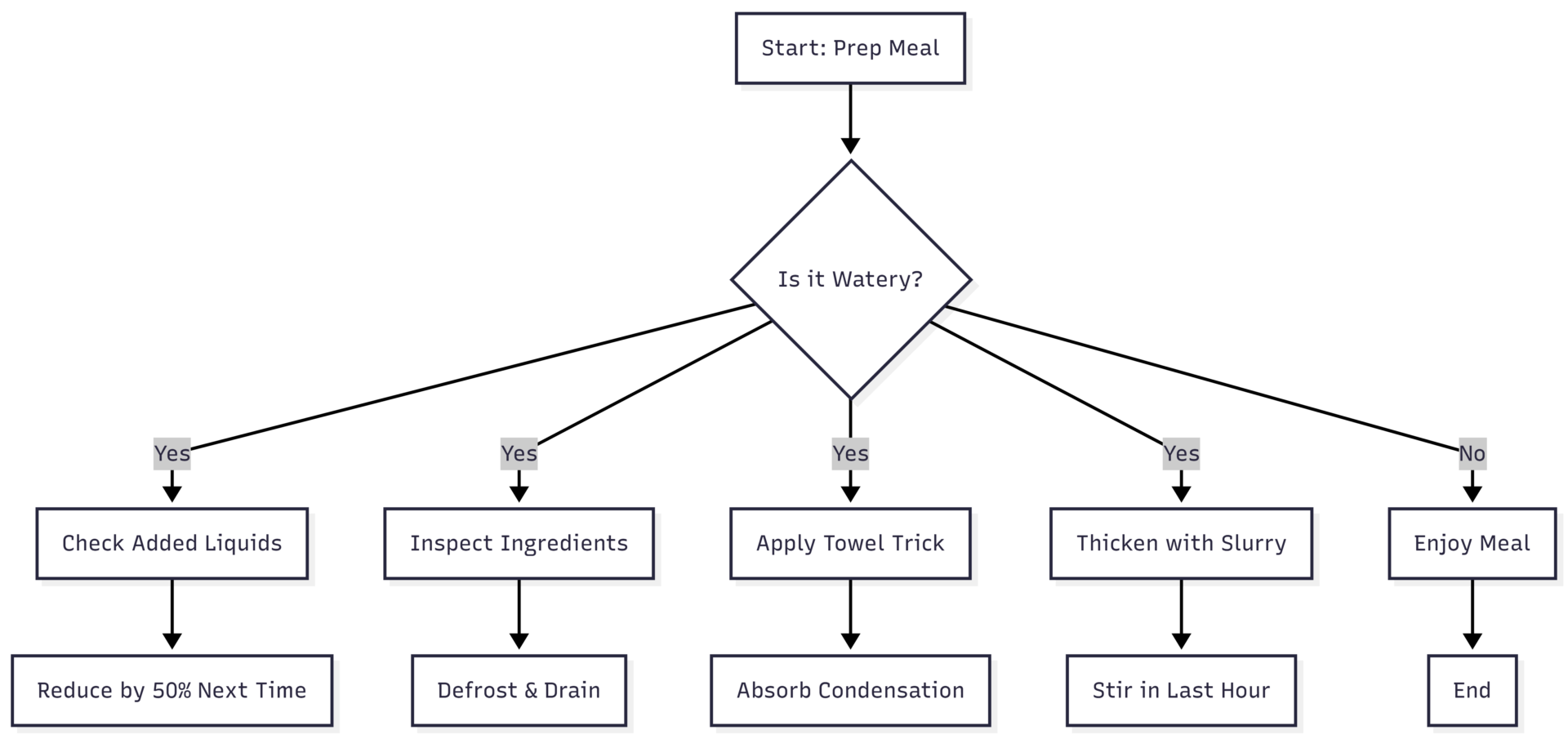
This diagram guides you through diagnosing and fixing issues logically.
Real-World Examples and Troubleshooting
Take a common scenario: 1.2kg diced chicken with broccoli, onion, carrots, potatoes, and 5 cups stock in a 4.5L cooker. After 5 hours on high, it’s soupy and bland. Fixes: Cut stock to 1 cup, sauté veggies, pat chicken dry, add tapioca, and evaporate lid-off.
Another: 1.2kg blade steak with onions, leeks, carrots, reduced tomatoes, and 1 cup stock for 8 hours on low—still watery and flavorless. Solutions: Brown steak first, amp seasonings, thicken end.
These echo community experiences, where over-liquidation is rampant. Adjusting yields tender, flavorful results.
Recommended Slow Cookers for Optimal Results
Choosing the right model enhances control. Based on current market leaders, here’s a table of top picks with specs and approximate prices (USD, as of current market data). These feature programmable settings for better moisture management.
To compile this, I used web searches for reliable sources like Consumer Reports and Amazon.
| Model | Capacity | Features | Price (USD) | Why Recommended |
|---|---|---|---|---|
| Crock-Pot 6-Quart Programmable | 6 Qt | Digital timer, high/low/warm, removable stoneware | 50-60 | Affordable, even heating prevents hot spots. |
| Instant Pot Duo 7-in-1 | 6 Qt | Slow cook + pressure, sauté function | 80-100 | Built-in sauté for pre-browning. |
| Hamilton Beach Set & Forget | 6 Qt | Probe thermometer, clip-tight lid | 60-70 | Temp probe ensures doneness without overcooking. |
| All-Clad Deluxe Slow Cooker | 7 Qt | Cast-aluminum insert, 20-hour timer | 200-250 | Premium build for consistent results. |
| Ninja Foodi PossibleCooker | 8.5 Qt | Sear/sauté, steam, slow cook | 100-120 | Versatile for moisture control techniques. |
Prices vary by retailer; check for deals. For small households, opt for 4-6 Qt; larger families need 7+ Qt.
Advanced Techniques for Flavor Mastery
Beyond basics, experiment with infusions: Layer herbs at bottom for aroma release. Use wine or beer sparingly for depth—alcohol evaporates minimally, so halve amounts.
For nutrition-focused meals, like work lunches, prioritize lean proteins and veggies but balance with thickeners. Science shows slow cooking preserves nutrients better than boiling, as lower temps minimize vitamin loss.
Incorporate global twists: For Indian curries, pre-toast spices; for Mexican chilis, add chipotle post-cook.
Conclusion: Elevate Your Slow Cooking
Watery, flavorless slow cooker meals stem from trapped moisture and unoptimized techniques, but with reductions, preps, and thickeners, you can achieve perfection. Implement these strategies for meals that are tender, rich, and satisfying. Your slow cooker isn’t the problem—it’s a tool waiting to shine.
Please share this Help me out here slow cookers. Watery and flavourless? with your friends and do a comment below about your feedback.
We will meet you on next article.
Until you can read, 5 Tips for Perfect Slow Cooker Meals