Slow Cooker Vs. Instant Pot: Which is best for your Kitchen?
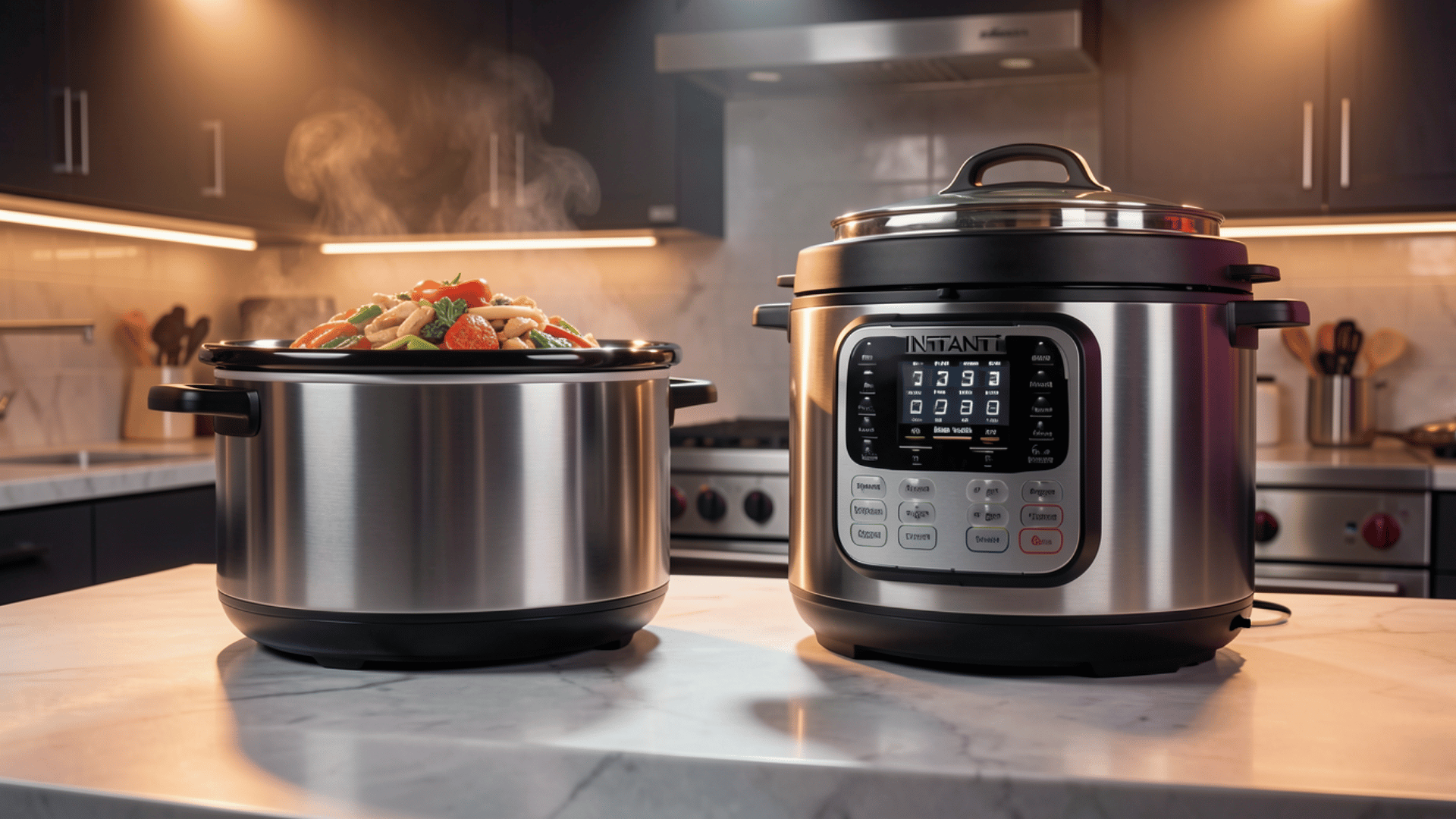
Two appliances dominate the modern home kitchen: the slow cooker and the Instant Pot. Both promise effortless meals, but they deliver on that promise in completely different ways. One is built for patience, the other for speed. Choosing between them — or deciding whether you actually need both — comes down to how you cook, how you plan, and what results matter most to you.
What Each Appliance Actually Does
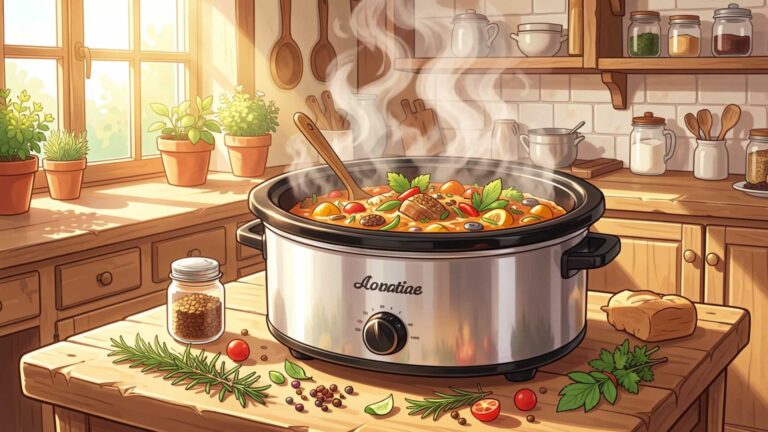
A slow cooker (commonly called a Crock-Pot) is a single-function countertop appliance that uses sustained low heat — typically between 170°F and 280°F — over a long period, usually 4 to 8 hours. It has a ceramic or stoneware insert, a glass lid, and a wrap-around heating element that distributes heat evenly. Most models offer just three settings: Low, High, and Keep Warm.
An Instant Pot is an electric multi-cooker. Its primary function is pressure cooking, which uses a sealed, airtight lid to trap steam and raise internal temperatures up to 250°F — well above what’s possible in an open pot. That pressurized environment cuts cook times by 30–70% compared to conventional methods. But the Instant Pot also sautés, steams, slow cooks, makes yogurt, and more — all in the same pot.
Specifications and Price Comparison
| Feature | Slow Cooker | Instant Pot (Duo 7-in-1) |
|---|---|---|
| Cooking Method | Low, sustained heat | Pressure, steam, sauté, slow cook |
| Typical Cook Time | 4–8 hours | 20–60 minutes (pressure) |
| Temperature Range | ~170°F–280°F | Up to 250°F (pressure mode) |
| Insert Material | Ceramic / Stoneware | Stainless Steel |
| Browning/Sautéing | No | Yes |
| Functions | 1 (slow cook) | 7+ |
| Typical Capacity | 4–8 quarts | 3, 6, or 8 quarts |
| Entry-Level Price | $20–$50 | $80–$130 |
| Mid-Range Price | $50–$80 | $130–$180 |
| Learning Curve | Very low | Moderate |
Cooking Results: What Does Each Do Best?
Slow Cooker Results
The slow cooker’s extended, moist heat environment is uniquely suited to breaking down collagen in tough cuts of meat. A chuck roast, pork shoulder, or lamb shank cooked for 8 hours on low will be fall-apart tender in a way that’s very difficult to replicate quickly. Vegetables soften gradually, and soups and stews develop a rounded, cohesive flavor because everything cooks together over time.
The trade-off is texture control. Delicate vegetables — zucchini, spinach, peas — can turn to mush if left in for a full cook cycle. Pasta and dairy also need to be added late in the process to prevent overcooking or curdling.
Instant Pot Results
Pressure cooking forces liquid into the food at high temperature and pressure, which means proteins cook faster but the flavor development is compressed. A pot roast that takes 8 hours in a slow cooker can be done in about 60–75 minutes in an Instant Pot. The result is tender, but some cooks note a slight difference in depth of flavor compared to the long-cooked version.
Where the Instant Pot genuinely excels is in tasks where speed matters without sacrificing quality: dried beans from scratch in under an hour, risotto without stirring, hard-boiled eggs that peel perfectly, and chicken stock in 45 minutes.
The sauté function is a major practical advantage. You can brown aromatics, sear meat, and then pressure cook — all in the same pot, without transferring to a skillet first.
Flavor Differences: Slow Cook vs. Pressure Cook
This is where the debate gets nuanced. Long, slow cooking develops flavor through a combination of Maillard reactions (browning), gradual fat rendering, and the slow integration of aromatics into a dish. The result in a slow cooker is often described as “layered” — each ingredient has time to contribute.
Pressure cooking achieves tenderness rapidly but doesn’t produce the same layered integration. However, the Instant Pot compensates through its sauté function: browning meat and onions before sealing the lid adds the Maillard-reaction complexity that pure pressure cooking alone skips.
Bottom line on flavor: For dishes where deep, slow-developed flavor is the point — beef stew, pulled pork, chili — a slow cooker often produces a more traditionally satisfying result. For weeknight efficiency where flavor is important but time is the constraint, a well-used Instant Pot comes very close.
Convenience: Set-and-Forget vs. Speed
The Slow Cooker Convenience Model
The slow cooker’s genuine advantage is unattended, all-day cooking. Load it in the morning, leave the house, and dinner is ready when you return. There’s no pressure release to manage, no steam valve, no “you need to be home for this.” For people who work long days or prefer to prep meals in the morning, this is irreplaceable.
The slow cooker also forgives imprecision. An extra hour on Low rarely ruins a dish. That kind of forgiving margin is valuable for new cooks.
The Instant Pot Convenience Model
The Instant Pot is convenient in a different way — it compresses time. Forgot to thaw the chicken? Didn’t plan dinner until 5pm? The Instant Pot can have a complete meal on the table in 30–45 minutes. It’s also the better appliance for spontaneous cooking.
The trade-off is active presence. Pressure cooking requires someone to be home to release the steam, check the seal, and monitor the process. It also has a learning curve around sealing, venting, and timing that can frustrate new users initially.
Note: The Instant Pot does include a slow cooker function, but many users report it doesn’t perform as consistently as a dedicated slow cooker. The temperature calibration differs, and the pot shape affects even heat distribution.
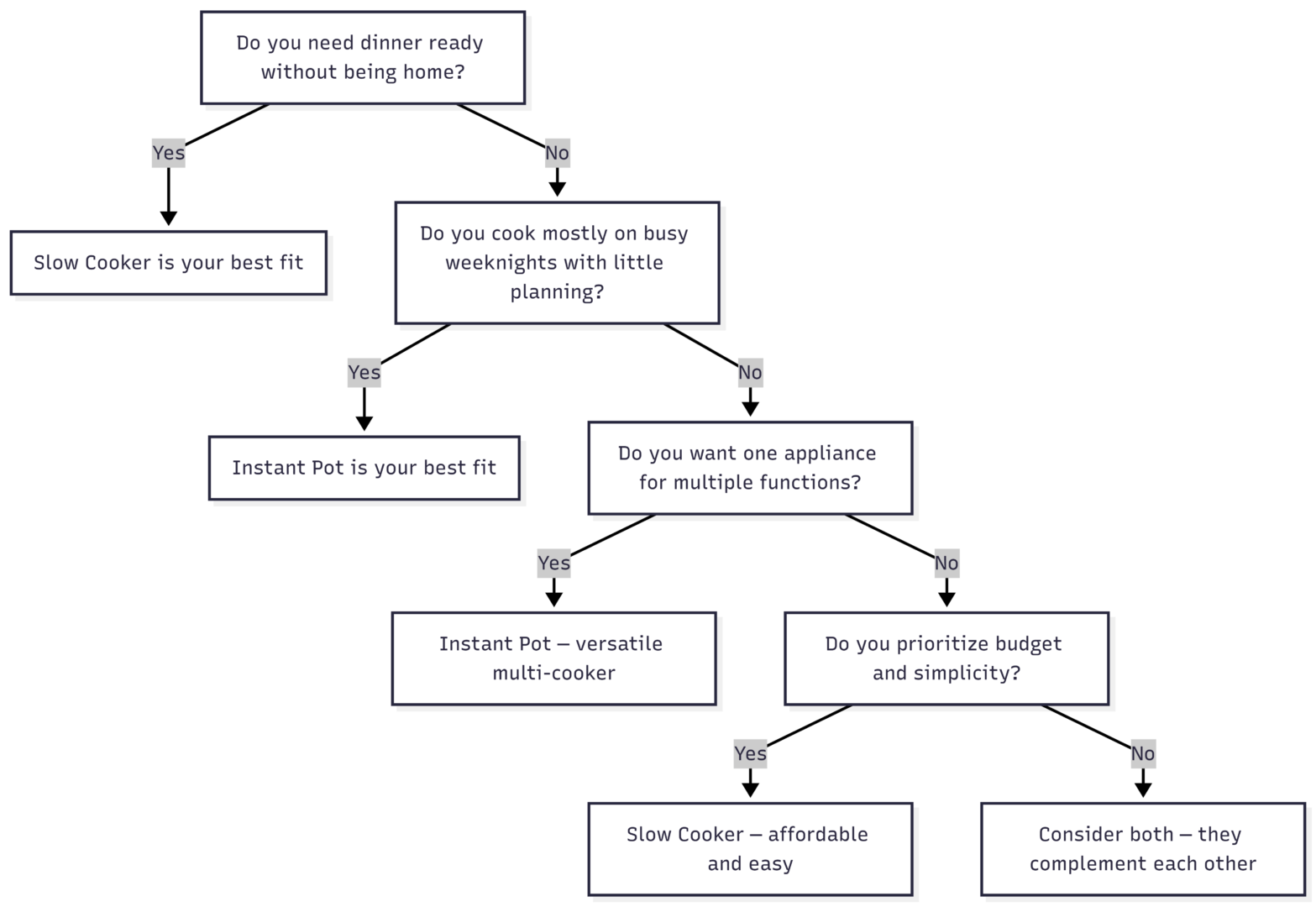
Decision Flowchart
Best Use Cases Side by Side
| Recipe Type | Best Appliance | Why |
|---|---|---|
| Chuck roast / pot roast | Slow Cooker | Long cook develops collagen and deep flavor |
| Weeknight chicken dinner | Instant Pot | Done in 20–25 minutes under pressure |
| Dried beans from scratch | Instant Pot | 45 min vs. 3–4 hours on stovetop |
| Chili or beef stew | Either (Slow Cooker preferred) | Slow cooker builds richer flavor over time |
| Risotto | Instant Pot | No stirring; results in ~8 minutes |
| Pulled pork | Slow Cooker | 8 hours on low = perfect texture |
| Hard-boiled eggs | Instant Pot | Easy-peel results consistently |
| Soups (all day) | Slow Cooker | Set and forget while you work |
| Chicken stock | Instant Pot | 45 minutes vs. 3+ hours on stove |
| Bread or desserts | Slow Cooker | Moist, even heat works well |
| Yogurt | Instant Pot | Dedicated yogurt function |
| Entertaining / large cuts | Slow Cooker | Hands-off, scales well for crowds |
Pros and Cons Summary
Slow Cooker
Pros:
- True set-and-forget operation — leave the house without worry
- Excellent at tenderizing tough, inexpensive cuts of meat
- Very low learning curve
- Affordable entry point ($20–$50)
- Forgiving cook times — extra time rarely ruins a dish
Cons:
- One cooking function only
- Requires advance planning — no quick weeknight saves
- No browning or sautéing capability
- Ceramic insert is heavy and can be fragile
- Delicate ingredients (dairy, pasta, fresh herbs) must be added late
Instant Pot
Pros:
- Dramatically faster — pressure cooking cuts time by 30–70%
- Sauté function allows browning in the same pot
- 7+ cooking functions replace multiple appliances
- Stainless steel insert is durable and non-reactive
- Excellent for dried beans, stocks, and grains
Cons:
- Higher cost ($80–$180)
- Steeper learning curve — sealing, pressure release, timing
- Bulkier and heavier than most slow cookers
- Requires active presence for pressure cooking
- Slow cooker mode is less reliable than a dedicated appliance
Who Should Buy Which?
Choose a slow cooker if:
- You want to prep in the morning and eat at night
- Budget is a primary concern
- You cook a lot of tough cuts, roasts, or all-day soups
- You’re a beginner who wants simple controls
- You entertain frequently and need hands-off large-batch cooking
Choose an Instant Pot if:
- You need meals on the table fast on busy weeknights
- You want to reduce your total number of kitchen appliances
- You frequently cook dried beans, grains, or stock from scratch
- You’re comfortable with a moderate learning curve
- You want the flexibility to decide what’s for dinner at 5pm
Consider both if:
- You cook for a large family with varied schedule needs
- You meal prep on weekends (slow cooker) and need quick fixes on weekdays (Instant Pot)
- Storage space allows for it
Final Verdict
Neither appliance is objectively better — they solve different problems. The slow cooker wins on simplicity, cost, and true hands-off convenience for long-cooked meals. The Instant Pot wins on speed, versatility, and the ability to adapt to an unplanned schedule.
If you can only choose one, ask yourself a single question: Do I cook more by planning ahead, or by figuring it out last minute? Plan-ahead cooks will get more daily use from a slow cooker. Last-minute cooks will reach for the Instant Pot every time.
If your kitchen has room for both, they complement each other more than they compete. The slow cooker handles Sunday roasts and weekday soups; the Instant Pot saves weeknight dinners and produces stock in under an hour. Together, they cover nearly every cooking scenario a home kitchen will face.
Please share this Slow Cooker Vs. Instant Pot: Which is best for your Kitchen? with your friends and do a comment below about your feedback.
We will meet you on next article.
Until you can read, How to prevent dairy separation in slow cooker recipes?